

Table of Contents
- Primal Pet Gear vs Boutique Brands: Quick Comparison
- What Sets Primal Pet Gear Apart
- Pet Gear Material Comparison: What Actually Matters
- Durable Dog Leash Reviews: Boutique Brands vs Mass-Market Options
- Best Heavy-Duty Dog Harness Features to Look For
- Pricing Breakdown: Where Your Money Goes
- Which Option Is Right for Your Pet
- Conclusion
Last Updated: August 18, 2026
Primal Pet Gear vs Boutique Brands: Quick Comparison
When you're shopping for primal pet gear vs boutique brands, you're really asking two different questions: Do I want mass-produced reliability or artisanal craftsmanship? Do I prioritize cost-per-unit or long-term durability? The answer depends entirely on your pet's needs, your budget, and what "durability" actually means to you.
At Lola's Favorite Pet Gear, we've tested both categories extensively. What we've found is that the comparison isn't about one being objectively better, it's about where each excels and where each falls short. Primal pet gear vs boutique brands represent two distinct philosophies: industrial-scale production optimized for consistent performance, versus smaller-batch creation focused on premium materials and customization.

The real insight? Most pet owners choose wrong because they're comparing the wrong things. They focus on price when they should focus on material durability. They chase brand names when they should chase specific features. Below, we'll show you exactly how to evaluate both categories and match them to your actual needs.
What Sets Primal Pet Gear Apart
Primal pet gear operates on a different manufacturing model than boutique producers. These brands typically source materials at scale, which means they can negotiate better prices on nylon webbing, stainless-steel hardware, and industrial-grade stitching. The tradeoff is that standardization replaces customization.
The real advantage of primal pet gear is consistency. When a brand manufactures 50,000 leashes per month, quality control becomes systematic. Every unit gets the same testing, the same material specifications, and the same hardware. You're not getting handcrafted uniqueness, but you're getting predictability. If a primal brand's harness holds up for three years, the next one you buy will likely hold up for three years too.
Primal brands also invest heavily in traffic control features and ergonomic design. Their dual-handle leashes come from understanding what works at scale, thousands of customer reviews feed back into product iteration. If 10,000 users report that a particular strap placement causes shoulder strain, the next production run changes it. Boutique brands rarely have that data volume.
The downside is that primal pet gear focuses on the 80% use case. If your dog is oddly-shaped, has anxiety, or has specialized needs, you might find that standard sizing doesn't work. Mass production optimizes for the bell curve, not the outliers.
Pet Gear Material Comparison: What Actually Matters
The material you choose determines lifespan more than any other factor. Here's what separates durable gear from gear that falls apart after six months.
Genuine leather (used in collars and some harnesses) comes in grades. Full-grain leather is thicker and ages better, it actually becomes softer and more flexible over time. Top-grain leather is thinner but still durable. Bonded leather is basically leather dust glued together; avoid it. Lola's Favorite Pet Gear's Classic Leather Dog Collar uses genuine cowhide with a water-resistant finish, which means it handles rain and daily wear without cracking.
Nylon webbing is the backbone of most harnesses and leashes. The difference between cheap and durable nylon is denier count and weave density. A 500-denier nylon feels flimsy. A 1000+ denier nylon has real structural integrity. Boutique brands often use higher denier counts because they're making fewer units and can absorb the material cost. Primal brands sometimes cut corners here to hit price targets.
Stainless-steel hardware matters more than people think. A cheap buckle will corrode after six months of exposure to salt air or moisture. Grade 304 stainless steel is the baseline for durability. Grade 316 is better and resists salt water longer. If a brand doesn't specify the steel grade, assume it's using something cheaper that will rust.
Stitching quality determines whether seams fail under load. Hand-stitched gear (common in boutique brands) uses thread patterns that distribute stress more evenly. Machine-stitched gear (common in primal brands) is faster but sometimes uses fewer passes per seam. For heavy-duty applications, you want at least 3-4 stitching passes at stress points like D-ring attachments.
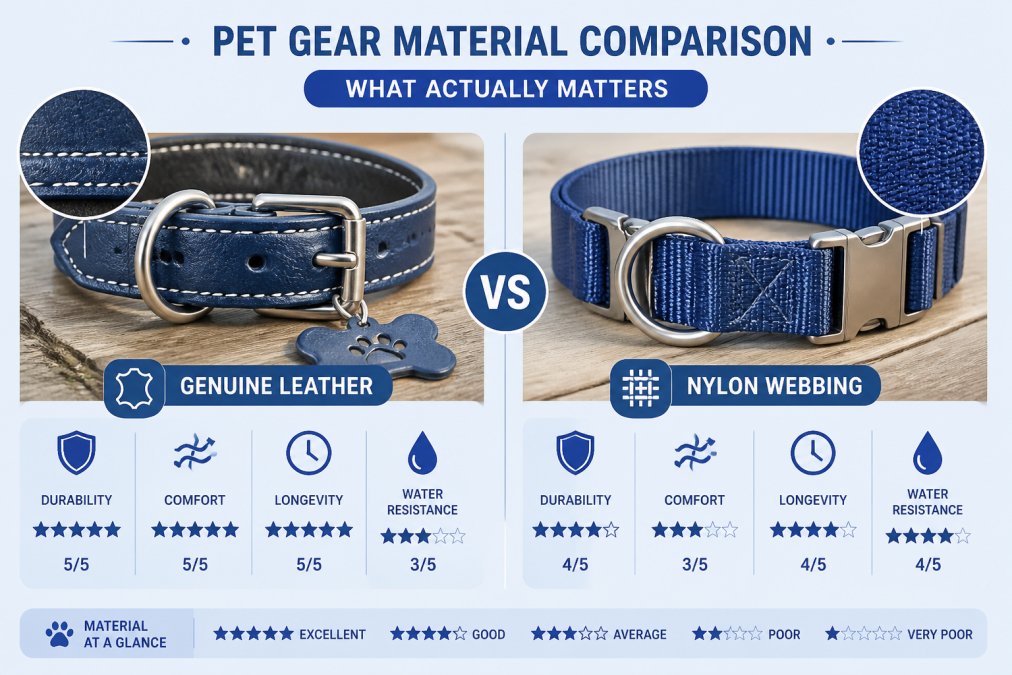
The takeaway: boutique brands often win on material sourcing because they can be selective. Primal brands win on consistency because they test every batch. Neither category automatically wins, you need to read the material specs.
Durable Dog Leash Reviews: Boutique Brands vs Mass-Market Options
When evaluating durable dog leash reviews, you're looking at two different performance profiles. Mass-market options (primal pet gear category) prioritize reliability across many dogs and conditions. Boutique leashes prioritize premium feel and customization.
A typical primal-brand leash handles dogs up to 100 lbs with consistent performance. The hardware won't fail, the stitching won't separate, and the handle won't fray. What you're getting is predictable durability. The LED Nylon Pet Safety Harness from Lola's Favorite Pet Gear exemplifies this, 100% durable nylon with rain-resistant electronics, designed to function reliably for 60+ hours of steady light or 80+ hours of flashing mode.

Boutique leash reviews often highlight superior comfort and aesthetic appeal. A handmade leather leash from a boutique maker might feature better handle ergonomics because the maker tested it personally. The leather might age beautifully because the tanner selected premium hides. But you're also paying 2-3x more, and if the maker goes out of business, you can't get a replacement.
The real difference emerges in edge cases. If you have a 150-lb dog that pulls hard, a boutique leash might not be rated for that load. If you need a specific color or custom engraving, a primal brand probably won't offer it. If you need a leash that works in saltwater environments, you need to check the hardware grade, boutique brands are more likely to specify Grade 316 stainless steel.
For most pet owners, a mass-market durable leash is the practical choice. You get reliability, you can replace it easily, and you're not overpaying for aesthetics you don't need. Boutique leashes make sense if you value customization, premium materials, or supporting small makers.
Best Heavy-Duty Dog Harness Features to Look For
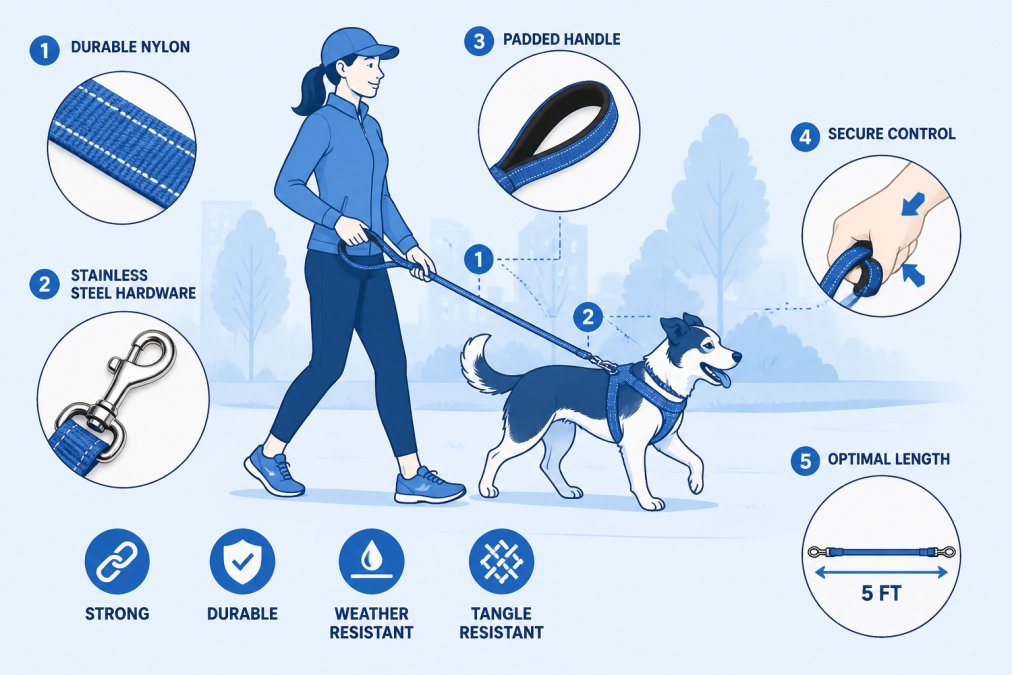
A heavy-duty dog harness needs three things: load rating, hardware durability, and adjustability. Most people get this wrong and focus on price instead.
Load rating is the maximum weight the harness can safely support under dynamic load (a dog pulling). A harness rated for 100 lbs should only be used on dogs under 80 lbs to account for impact. If your dog weighs 90 lbs and pulls hard, you need a harness rated for 150+ lbs. Primal brands publish load ratings clearly. Boutique brands sometimes don't, which is a red flag.
Hardware attachment determines whether your harness fails when your dog lunges. Look for reinforced D-rings, the metal loop where the leash connects. It should be welded or riveted, not just glued. The attachment point should have multiple stitching passes (at least 3-4) around the perimeter. If you see a single stitch line around a D-ring, that harness will fail under sustained pulling.
Adjustability matters because dogs come in weird shapes. A harness with five adjustment points (chest, shoulder, belly, back, and neck) accommodates more body types than one with two. Lola's Favorite Pet Gear's Waterproof Dog Harness Jacket includes adjustable harness straps on the back, allowing you to customize the fit for your specific dog's proportions.

Padding reduces pressure points during long walks. A thin nylon harness works fine for a 15-minute walk. A padded harness (especially for senior dogs or dogs with anxiety) distributes load more evenly and reduces shoulder strain.
The best heavy-duty dog harness feature you can't see is the testing protocol. Legitimate brands test harnesses to failure, they load them with sandbags and pull until something breaks. They report the failure point. If a brand doesn't mention testing, assume they haven't done it.
Pricing Breakdown: Where Your Money Goes
Here's what you're actually paying for when you choose primal pet gear vs boutique brands.
A mass-market harness from a primal brand typically costs $30-60. That breakdown looks like: $8 materials, $4 labor, $5 overhead, $8 shipping/logistics, $10 retailer margin, $15 brand profit and marketing.
A boutique harness typically costs $80-150. The breakdown: $25 materials (premium leather, better hardware), $12 labor (smaller batches, more attention), $8 overhead (smaller operation), $10 shipping, $15 retailer margin, $30 brand profit.
The material difference is real but not huge, the boutique brand is spending 3x more on materials, not 10x. The rest is paying for smaller production volumes, more customization, and brand positioning.
For Lola's Favorite Pet Gear products, you're paying for tested durability and style. The Classic Leather Dog Collar at $56.99 includes genuine cowhide and stainless-steel hardware. The Waterproof Dog Harness Jacket at $60.99 combines functionality (built-in harness) with weather protection. The LED Nylon Pet Safety Harness at $48.99 adds visibility features that boutique brands rarely offer. The Dog Travel Car Seat Carrier at $111.99 provides multi-purpose functionality, car seat, shoulder carrier, and seat cover in one.
| Product | Price | Material | Best For | Durability |
|---|---|---|---|---|
| Classic Leather Collar | $56.99 | Genuine cowhide | Daily wear, style | 3-5 years |
| Waterproof Harness Jacket | $60.99 | Nylon + fleece | Weather protection | 2-3 years |
| LED Safety Harness | $48.99 | Nylon webbing | Night visibility | 2-3 years |
| Car Seat Carrier | $111.99 | Oxford cloth + PVC | Travel safety | 3-4 years |
The value question isn't "Is this cheaper?" It's "Does this last longer than the price difference?" A $40 harness that lasts 18 months costs $26.67 per month. A $100 harness that lasts 4 years costs $2.08 per month. Durability compounds the value.
Which Option Is Right for Your Pet
The decision framework is simpler than most guides make it.
Choose primal pet gear if:
- Your dog is a standard size and shape (fits regular harness sizing)
- You prioritize reliability over aesthetics
- You're willing to replace gear every 2-3 years
- You need to buy quickly and don't want to wait for custom orders
- Your dog doesn't have special needs (anxiety, sensitivity, mobility issues)
- You want documented load ratings and safety testing
Choose boutique brands if:
- Your dog is oddly-shaped and standard sizing doesn't fit
- You want premium materials and craftsmanship
- You value customization (monograms, specific colors, custom sizing)
- You're willing to pay 2-3x more for perceived quality
- You want to support small makers
- You need specialized gear (anxiety wraps, senior dog support, etc.)
The hybrid approach: Buy primal gear for everyday use (leashes, standard harnesses, travel carriers) and boutique gear for specialized needs. This is what most experienced pet owners do. You get reliability where you need it and customization where it matters.
For most pet owners, Lola's Favorite Pet Gear hits the sweet spot. You're getting tested durability and thoughtful design without paying for unnecessary customization. The Pet Space Capsule Carrier Backpack at $165.99 offers features, panoramic visibility, escape-proof design, breathable mesh, that boutique carriers rarely include. The Dog Travel Car Seat Carrier at $111.99 provides versatility (car seat, shoulder carrier, seat cover) that justifies the price against single-purpose alternatives.
Conclusion
The primal pet gear vs boutique brands decision isn't about choosing the objectively "better" option. It's about matching the right tool to your actual needs. Primal brands win on consistency, load rating documentation, and cost-per-use. Boutique brands win on material sourcing, customization, and the feeling of owning something special.
Most pet owners benefit from primal gear for everyday use. The durability is proven, the features are practical, and you're not overpaying for aesthetics. When your dog's needs are standard, regular sizing, no special sensitivities, normal activity level, mass-market reliability beats artisanal appeal every time.
Frequently Asked Questions
What's the main difference between Primal Pet Gear and boutique brands?
Primal Pet Gear positions itself as a mass-market option with competitive pricing and accessible product range. Boutique brands, including specialized retailers like Lola's Favorite Pet Gear, typically focus on premium materials, craftsmanship, and niche features, such as genuine leather construction, custom sizing, or specialized designs like the AquaPaws™ Portable Pet Bottle. Boutique brands often emphasize ingredient transparency, sourcing ethics, and durability testing, while mass-market options prioritize affordability and convenience factor.
Are boutique pet brands worth the higher price?
It depends on your priorities. Boutique brands justify premium pricing through superior materials (genuine leather vs. synthetic), rigorous quality standards, and specialized product features. For example, Lola's Favorite Pet Gear's Classic Leather Dog Collar ($56.99) uses genuine cowhide with stainless-steel hardware designed for long-term durability. If your pet spends significant time outdoors or you prioritize ergonomic design and aesthetic appeal, boutique options often deliver better value over time through reduced replacement costs and enhanced comfort.
What materials should I look for in high-quality pet gear?
Look for genuine leather (cowhide or similar), heavy-duty stainless-steel hardware, and weather-resistant fabrics like waterproof nylon webbing. Genuine leather offers superior durability and water resistance compared to synthetic alternatives. Stainless-steel buckles and D-rings won't rust or corrode, extending product lifespan. For harnesses and jackets, seek breathable, reinforced nylon with detailed stitching and padding. Premium brands test materials for pathogen resistance and durability, ensuring your pet's gear withstands daily wear and outdoor conditions.
How do I know if a boutique pet brand is actually reliable?
Check for ingredient transparency, sourcing ethics documentation, and customer reviews from verified purchases. Reputable boutique brands like Lola's Favorite Pet Gear provide detailed product specifications, warranty information, and responsive customer service. Look for brands that offer money-back guarantees, have published durability testing results, and maintain active customer communities. Long-standing boutique brands with consistent positive reviews and strong return policies demonstrate commitment to quality and customer satisfaction.
Ready to upgrade your pet's gear with products designed for real durability and comfort? Explore Lola's Favorite Pet Gear's collection of tested harnesses, collars, and travel carriers. From the Classic Leather Dog Collar with stainless-steel hardware to the Waterproof Dog Harness Jacket with built-in control features, our products combine functionality with style. Shop Now and discover why pet owners trust Lola's Favorite Pet Gear for everyday care that lasts.
This article was written using GrandRanker